Showing posts with label Uber. Show all posts

25 October, 2014

Who's Afraid of a Little Competition?

More people than you think. In a recent article in Forbes magazine, Art Carden explains the difference between being pro-business and pro- free market. There are many businesses large and small along with just as many politicians who may take a pro-business stance but who are decidedly anti- free market.

Carden goes on to illustrate the difference between the two notions:
"A private company wants a patch of ground on which to build a hotel, a grocery store, a shopping center, or an office building. The “pro-business” solution is to seize the land via eminent domain and claim that the increased tax revenue is a public benefit (if increased tax revenue is going to be our standard, why don’t we compel labor force participation and make everyone sell their property to special interests?). The free market solution says “if the owner will sell to you, it’s yours, but don’t expect to be able to get government officials with guns to go get it for you.”
Pro-business essentially means making laws or implementing regulations that will benefit one business or industry at the expense of another. This is also known as picking winners and losers in the marketplace. Rather than not providing any government favors or assistance whatsoever and letting the market i.e. consumers, decide which products and services are worthwhile, governments instead substitute their judgement for the judgement of the consumers.


Businesses themselves often try and work counter to the free market by lobbying the government to write laws or regulations that will benefit them at the expense of some of their competitors. If one wonders how we get money out of politics, one must look to the source of why there is money in politics in the first place. In his succinctly classic book, The Law, French philosopher Frederic Bastiat put his thumb on the problem two and a half centuries ago.
"Sometimes the law defends plunder and participates in it. Thus the beneficiaries are spared the shame and danger that their acts would otherwise involve… But how is this legal plunder to be identified? Quite simply. See if the law takes from some persons what belongs to them and gives it to the other persons to whom it doesn’t belong. See if the law benefits one citizen at the expense of another by doing what the citizen himself cannot do without committing a crime. Then abolish that law without delay - No legal plunder; this is the principle of justice, peace, order, stability, harmony and logic.”
When we turn the law from an instrument of merely protecting property into an instrument of plunder, "...then everyone will want to participate in making the law, either to protect himself against plunder or to use it for plunder.”

We see this today in modern examples. I've mentioned  before the plight of new ride sharing apps like Uber and Lyft who are being prohibited from operating in certain states and jurisdictions. In many cases this is due to the taxi cab industry lobbying the government to erect laws preventing any competition from entering into the market. This benefits the taxi cabs at the expense of these new start-ups and at the expense of the consumers yet nonetheless it could still be construed as a "pro-business" maneuver by legislators.

Similarly, the popular accommodations provider, Airbnb, has come under fire in many large cities. There are certainly some legal fig leaves that give complaints about such businesses an air of credibility, but at the heart of it you can be sure to find the powerful hotel lobby amongst many others behind the scenes creating a stink trying to get legislators to "do something" about this pesky new business model that is causing them to lose business.

One will often hear liberals and progressives cry for tougher regulations on corporations and industries that have come under fire for one reason or another. They often call for these regulations in a misguided attempt to try and diminish the power of these corporations (who run our lives, dontchyaknow?) without realizing that many regulations actually benefit the largest corporations at the expense of smaller businesses.

Think about it, if you're Walmart or Amazon, industry giants, and the government slaps another regulation on that industry, closing a tax loophole, for instance, which will increase the cost of compliance and cause a monumental increase in paperwork to be filed for the regulatory agencies, who do you think is going to feel the brunt of this regulation the most? Will it be Walmart with billions of dollars in sales or will it be a smaller competitor, perhaps a local chain trying to go national that is still operating under thin margins while trying to gain a foothold in the industry? In the end, sure Walmart might have to pay extra to file their paperwork but it will hardly be a dent in their bottom line whereas the same regulation might be acutely felt and even completely stifle any growth of a potential competitor. In trying to diminish the power of a corporate giant, some of these regulations have the complete opposite effect which is to make competition imminently more expensive and cost prohibitive for smaller businesses thereby stifling competition.

It is no accident that after the passage of Dodd-Frank in the wake of the financial crisis, a leviathan of a bill with over 2,000 pages of legalese, that the Too Big To Fail banks the bill was intended to regulate are now even bigger than they were five years ago and the number of banks in America is at an all time record low.

Industry giants are very aware of this regulatory phenomenon and, believe it or not, are actually often the source of government lobbying for increased regulations. A very clever way of increasing market share while giving the appearance of trying to be responsible corporate entities.

It is important we remember these differences and allow the free market to let new businesses freely enter and exit the business arena. We all benefit from this by increased consumer choice, more job/income opportunities, a better allocation of tax dollars, and better uses of resources. Who's afraid of a little competition? It turns out, quite a lot of people. Competition is cutthroat, as anyone who pays attention to sports knows, but it is also the vehicle through which improvements, innovations, and advancements are made. Rather than fear it and try and regulate and legislate competition out of existence, we should embrace it and welcome the advancements that emerge when businesses are forced to legitimately compete in the marketplace of ideas. 


29 July, 2014

In Defense of Capitalism

I made the mistake of commenting on an article I saw on Facebook the other day. For the most part, I've more or less learned to refrain from getting into arguments with strangers over Facebook or through the comment sections of articles I read. You have about as good a chance of convincing these people of the righteousness of your argument as you do in convincing Liberace that sequins and gold don't have to be wardrobe staples.

Alas, I have a fatal flaw, though, in that if I see stupid in the world, I feel the need to try and correct it. Hence this blog. Hence my futile efforts at trying to convince some avowed socialists that capitalism, far from being the cause of world poverty and hunger, has actually done more than any other system known to man to lift people and countries out of poverty.


The title of the article was Capitalism and Global Poverty: Two Billion Poor, One Billion Hungry and the little preview snippet of the article read, "The report describes the conditions produced by capitalism—mass poverty, deprivation, social injustice, inequality, oppression—but makes no reference to capitalism. There is simply no mention of the economic system under which the world’s population lives, and thus no discussion of any alternative." Oy vey.

Enter Haley, stage left: "Sorry, wrong. Capitalism has brought more people out of poverty than any other system. Bread lines don't happen under capitalism. Food shortages don't happen under capitalism. Millions and millions of people starved and died under the communist and socialist regimes of China and Russia. Venezuela is lacking basic necessities under their socialist regime. Sorry, you can't blame capitalism for hunger and poverty unless you bastardize the definition of capitalism."

Then the stupid comes: "I believe that polls show that majorities in 'liberated' Warsaw Pact countries miss communism. They thought it was bad - until they experienced predatory capitalism..." I'd like to see these polls and talk to some of those Chinese and Russians who lived under Mao and Stalin and see if they really did enjoy living under those regimes more than current ones. 

This guy here really lets me have it: "Why is that always ignorant people defend capitalism with a counter argument of communism? have you personally ever lived in a real communist country? I gusse not, I am sure you have not even been across the state line." Yeah, sure, as I write this from the Bahamas. And fortunately, no, I haven't ever lived in a real communist country as there are hardly any left in existence anymore because people have figured out that it doesn't work!

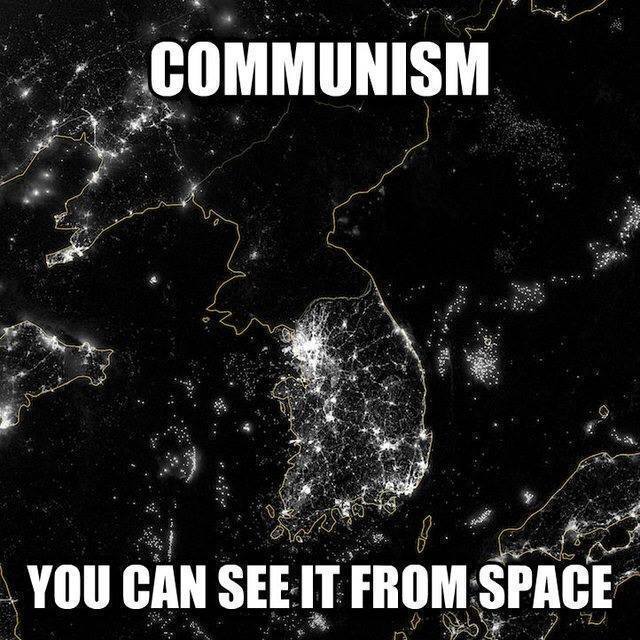
Not only does it not work, if only it were as simple as "Oops, this didn't work. Let's try something else." No, when socialism and communism fail, they take millions and millions of people down with it. In fact, apart from WWI and WWII, deaths due to communism and socialism were the greatest cause of death than any other cause in the 20th century. It's estimated that 85-100 million people died under these regimes. How are we even debating this? How are people still even thinking that socialism might be more ideal than capitalism? When capitalism fails (and of course these failures are due to government intervention) mass deaths do not happen. Worst case scenario: greedy companies run shady businesses that bilk people out of their life savings. Irrefutably immoral and reprehensible, but millions of people do not die as a consequence. Moderate case scenario: You can't afford an iPhone 5 and instead have to get the Sprint smart phone instead. Oh the horrors of capitalism.

People aren't literally starving to death in countries where they have a relatively free market. People aren't risking their lives on makeshift rafts trying to get away from their oppressive capitalist country for the shores of their communist neighbor. No! People are seeking out freedom, which is what capitalism, in its pure form at least, represents. Even in its bastardized, corporatist form that we experience today, the results are still better than they ever were under socialism. 

I know there are tomes of economic texts out there and you can find any multitude of economists to support your chosen economic system, but let's put this as simply as possible. Capitalism is referred to as the free market, with "free" being the operative word here. You have a boat. I wish to buy a boat. We trade your boat for my money and bingo! That's the free market. There's no force or coercion involved to complete the transaction. We are both better off because of the transaction or else the transaction never would have occurred. I would have kept my money and spent it on something else and you would have sold your boat to someone else if one of us were unhappy with the terms of the sale. Multiply millions of transactions like this everyday and you have the flourishing of a system where people mutually benefit by acting on behalf of their own self interests. This is how our fledgling country developed from nothing to a world superpower in just over a century.

The problems arise when government starts trying to interfere with these freely entered into arrangements. Take the current example of Uber, for instance. Uber is a popular ride sharing enterprise that is starting to displace taxicabs because of its convenience and affordability. Here you have a person or enterprise trying to bring a service to the market, to fulfill a need or a void in the marketplace that they thought the taxicabs weren't filling. On the other hand, you have tens of thousands of willing customers who have found their business model to be much more appealing than the traditional taxicab and have chosen to spend their money freely with Uber. Everyone wins, right? Wrong. Despite this freely entered into business transaction, the government in some states and cities has felt the need to try and ban Uber or severely limit their business. This is a lose-lose. The entrepreneur loses out on potential income and the consumer loses out on a cheaper, more efficient mode of transportation. The only winner in this equation is the taxi cab cabal who has successfully lobbied the government to drive out their competition. Innovation and ingenuity has been stifled. The government flashed the gun hidden underneath its cloak using the implied threat of violence in order to quash this business venture and bestow favor upon another business or industry. 

Therein lies the problem with systems that rely on an excessive amount of government control. The government's only tool is its monopoly on violence and its implied threats thereof. That's why the communist and socialist regimes of the 20th century had such catastrophic results. Not only because these governments presumed to be above the laws of economics, as if they could avoid those laws anymore than they could avoid the laws of gravity, which had disastrous effects on supply and demand causing shortages of daily necessities resulting in mass famine amongst other things, but because their massive overreach into their economies and the free market required violence to subvert the free will of its citizens. 

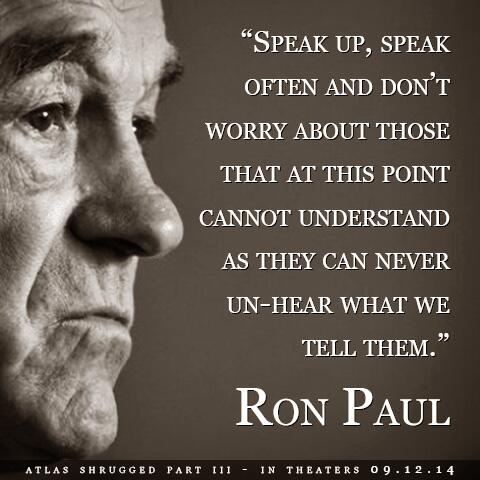
It was because of these -what should be obvious- facts that I felt the need to go drop some truth bombs on these severely misguided people. As expected, I'm quite certain I failed to persuade anyone to step into the light. That won't keep me from trying, however. As Ron Paul has famously said, "Speak up, speak often and don't worry about those that at this point cannot understand as they can never un-hear what we tell them." 


As for those who are open to learning more about the free market, capitalism, economics, and history, I have a few recommendations all brought to you by the indispensable Tom Woods who, apart from Ron Paul, is by far my favorite figure in the liberty movement. 

For an introductory tidbit that requires minimal time commitment, I offer a brilliant speech that Tom Woods gave in defense of capitalism called "Why Economic Freedom? Here's Why": https://www.youtube.com/watch?v=TnS2OtzSTq0

If you want to delve a little deeper, any of Tom Woods's books are worth reading but in particular regarding this topic I would recommend Meltdown: A Free-Market Look at Why the Stock Market Collapsed, the Economy Tanked, and Government Bailouts Will Make Things Worse.  

And lastly, for an invaluable resource at a phenomenal price, there is the Tom Woods's Liberty Classroom: The History and Economics They Didn't Teach You. This gives you a high school or beginning college level introduction to many topics taught by actual university professors. Some of the classes include: The American Revolution, History of Political Thought, Austrian Economics Step-By-Step, U.S. History, and Introduction to Logic. Additionally, each course has a corresponding forum where you can ask the professors questions and get clarification on some of the lectures being taught. They also do a monthly webinar with the professors where you can ask your questions and have them answered live on the spot. How much would you pay to get similar courses and access in college? $5000/year? Would you believe that Liberty Classroom will only cost you 1% of that amount? For the mathematically challenged like me, that's 50 bucks. Fifty dollars gets you an awesome introductory education on topics that are more relevant than ever so you can go into a Facebook debate armed with information, for whatever good it will do you ;) A superb value if I ever saw one.