Showing posts with label poverty. Show all posts

29 July, 2014

In Defense of Capitalism

I made the mistake of commenting on an article I saw on Facebook the other day. For the most part, I've more or less learned to refrain from getting into arguments with strangers over Facebook or through the comment sections of articles I read. You have about as good a chance of convincing these people of the righteousness of your argument as you do in convincing Liberace that sequins and gold don't have to be wardrobe staples.

Alas, I have a fatal flaw, though, in that if I see stupid in the world, I feel the need to try and correct it. Hence this blog. Hence my futile efforts at trying to convince some avowed socialists that capitalism, far from being the cause of world poverty and hunger, has actually done more than any other system known to man to lift people and countries out of poverty.


The title of the article was Capitalism and Global Poverty: Two Billion Poor, One Billion Hungry and the little preview snippet of the article read, "The report describes the conditions produced by capitalism—mass poverty, deprivation, social injustice, inequality, oppression—but makes no reference to capitalism. There is simply no mention of the economic system under which the world’s population lives, and thus no discussion of any alternative." Oy vey.

Enter Haley, stage left: "Sorry, wrong. Capitalism has brought more people out of poverty than any other system. Bread lines don't happen under capitalism. Food shortages don't happen under capitalism. Millions and millions of people starved and died under the communist and socialist regimes of China and Russia. Venezuela is lacking basic necessities under their socialist regime. Sorry, you can't blame capitalism for hunger and poverty unless you bastardize the definition of capitalism."

Then the stupid comes: "I believe that polls show that majorities in 'liberated' Warsaw Pact countries miss communism. They thought it was bad - until they experienced predatory capitalism..." I'd like to see these polls and talk to some of those Chinese and Russians who lived under Mao and Stalin and see if they really did enjoy living under those regimes more than current ones. 

This guy here really lets me have it: "Why is that always ignorant people defend capitalism with a counter argument of communism? have you personally ever lived in a real communist country? I gusse not, I am sure you have not even been across the state line." Yeah, sure, as I write this from the Bahamas. And fortunately, no, I haven't ever lived in a real communist country as there are hardly any left in existence anymore because people have figured out that it doesn't work!

Not only does it not work, if only it were as simple as "Oops, this didn't work. Let's try something else." No, when socialism and communism fail, they take millions and millions of people down with it. In fact, apart from WWI and WWII, deaths due to communism and socialism were the greatest cause of death than any other cause in the 20th century. It's estimated that 85-100 million people died under these regimes. How are we even debating this? How are people still even thinking that socialism might be more ideal than capitalism? When capitalism fails (and of course these failures are due to government intervention) mass deaths do not happen. Worst case scenario: greedy companies run shady businesses that bilk people out of their life savings. Irrefutably immoral and reprehensible, but millions of people do not die as a consequence. Moderate case scenario: You can't afford an iPhone 5 and instead have to get the Sprint smart phone instead. Oh the horrors of capitalism.

People aren't literally starving to death in countries where they have a relatively free market. People aren't risking their lives on makeshift rafts trying to get away from their oppressive capitalist country for the shores of their communist neighbor. No! People are seeking out freedom, which is what capitalism, in its pure form at least, represents. Even in its bastardized, corporatist form that we experience today, the results are still better than they ever were under socialism. 
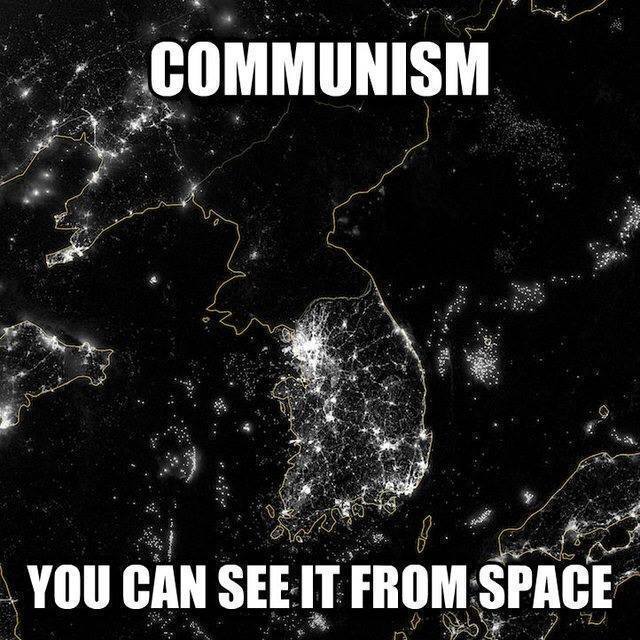
I know there are tomes of economic texts out there and you can find any multitude of economists to support your chosen economic system, but let's put this as simply as possible. Capitalism is referred to as the free market, with "free" being the operative word here. You have a boat. I wish to buy a boat. We trade your boat for my money and bingo! That's the free market. There's no force or coercion involved to complete the transaction. We are both better off because of the transaction or else the transaction never would have occurred. I would have kept my money and spent it on something else and you would have sold your boat to someone else if one of us were unhappy with the terms of the sale. Multiply millions of transactions like this everyday and you have the flourishing of a system where people mutually benefit by acting on behalf of their own self interests. This is how our fledgling country developed from nothing to a world superpower in just over a century.

The problems arise when government starts trying to interfere with these freely entered into arrangements. Take the current example of Uber, for instance. Uber is a popular ride sharing enterprise that is starting to displace taxicabs because of its convenience and affordability. Here you have a person or enterprise trying to bring a service to the market, to fulfill a need or a void in the marketplace that they thought the taxicabs weren't filling. On the other hand, you have tens of thousands of willing customers who have found their business model to be much more appealing than the traditional taxicab and have chosen to spend their money freely with Uber. Everyone wins, right? Wrong. Despite this freely entered into business transaction, the government in some states and cities has felt the need to try and ban Uber or severely limit their business. This is a lose-lose. The entrepreneur loses out on potential income and the consumer loses out on a cheaper, more efficient mode of transportation. The only winner in this equation is the taxi cab cabal who has successfully lobbied the government to drive out their competition. Innovation and ingenuity has been stifled. The government flashed the gun hidden underneath its cloak using the implied threat of violence in order to quash this business venture and bestow favor upon another business or industry. 

Therein lies the problem with systems that rely on an excessive amount of government control. The government's only tool is its monopoly on violence and its implied threats thereof. That's why the communist and socialist regimes of the 20th century had such catastrophic results. Not only because these governments presumed to be above the laws of economics, as if they could avoid those laws anymore than they could avoid the laws of gravity, which had disastrous effects on supply and demand causing shortages of daily necessities resulting in mass famine amongst other things, but because their massive overreach into their economies and the free market required violence to subvert the free will of its citizens. 

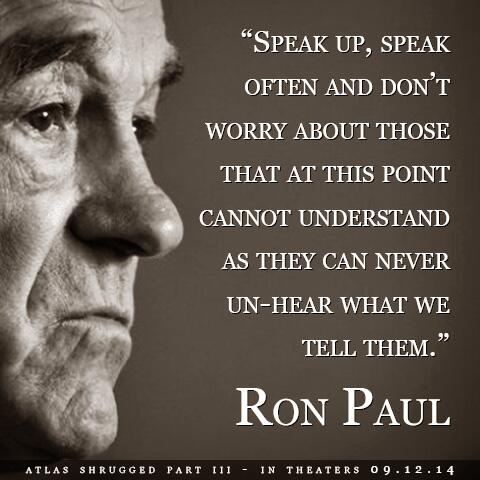
It was because of these -what should be obvious- facts that I felt the need to go drop some truth bombs on these severely misguided people. As expected, I'm quite certain I failed to persuade anyone to step into the light. That won't keep me from trying, however. As Ron Paul has famously said, "Speak up, speak often and don't worry about those that at this point cannot understand as they can never un-hear what we tell them." 


As for those who are open to learning more about the free market, capitalism, economics, and history, I have a few recommendations all brought to you by the indispensable Tom Woods who, apart from Ron Paul, is by far my favorite figure in the liberty movement. 

For an introductory tidbit that requires minimal time commitment, I offer a brilliant speech that Tom Woods gave in defense of capitalism called "Why Economic Freedom? Here's Why": https://www.youtube.com/watch?v=TnS2OtzSTq0

If you want to delve a little deeper, any of Tom Woods's books are worth reading but in particular regarding this topic I would recommend Meltdown: A Free-Market Look at Why the Stock Market Collapsed, the Economy Tanked, and Government Bailouts Will Make Things Worse.  

And lastly, for an invaluable resource at a phenomenal price, there is the Tom Woods's Liberty Classroom: The History and Economics They Didn't Teach You. This gives you a high school or beginning college level introduction to many topics taught by actual university professors. Some of the classes include: The American Revolution, History of Political Thought, Austrian Economics Step-By-Step, U.S. History, and Introduction to Logic. Additionally, each course has a corresponding forum where you can ask the professors questions and get clarification on some of the lectures being taught. They also do a monthly webinar with the professors where you can ask your questions and have them answered live on the spot. How much would you pay to get similar courses and access in college? $5000/year? Would you believe that Liberty Classroom will only cost you 1% of that amount? For the mathematically challenged like me, that's 50 bucks. Fifty dollars gets you an awesome introductory education on topics that are more relevant than ever so you can go into a Facebook debate armed with information, for whatever good it will do you ;) A superb value if I ever saw one. 


12 January, 2014

3 Myths About Libertarianism Debunked

I'm baaack! Many apologies to anyone who reads this semi-regularly for my delay in posts. If you've read my bio, you know that my full-time job is as a yacht crew member and the end of the year is always crazy for us. Since December, I've been working 12-16 hour days almost every day, which leaves very little time, energy, or motivation to even keep up with current events nonetheless blog about them! But things have settled down a bit for now so I'll try and bang out a couple of blogs in the next week or two before things get crazy again.

Today, I want to tackle a few of the prominent misconceptions that seem to plague libertarianism that its detractors either don't fully understand or don't care to. Let's dive in.

1) Libertarians don't care about the poor, sick, or elderly
Really? I mean, really? Do you really think there is a huge, growing swath of individuals who really could care less if their own grandmothers died or that there are poor children in the U.S. and elsewhere without food to eat? Of course libertarians care about the elderly, poor, and sick. We just have a different notion of how to deal with social problems than many others.

First of all, we don't believe that using State initiated violence will ever be the way to solve any sort of complex societal problem. Problems like poverty and poor healthcare are extremely complex and have many origins. Using the state's monopoly on violence to rob individuals of their wealth to redistribute to other politically favored groups is hardly a panacea to problems that require more than just someone else's money to solve.

Contrary to popular opinion, libertarians don't want to throw granny off the cliff

Individuals, businesses, and communities need to be empowered to deal with the unique situations that each of them face that lead to lack of healthcare access or income inequality. While having access to resources, including money, is certainly part of solving any big scale problem, stealing someone's money and then handing it out to politically connected individuals and businesses does not appeal to libertarians who prefer to let people and businesses keep their money and voluntarily give their resources to charities and businesses that they believe do good work in helping to alleviate these problems.

Let's think about this for a second. If there was no Social Security, no Medicare, no Medicaid, or any other programs of those types, given the number of people who obviously care about access to healthcare and who wish to end world poverty, do you think all those millions of individuals would just sit idly by as people were dying in the streets because there was no government healthcare or safety net set in place for retirees? Or do you think that out of those millions of people in the U.S. who clearly care about the sick and elderly that maybe a few thousand of them across the nation might somehow take it upon themselves to start up organizations, charities, or businesses that address these problems and come up with any number of solutions unique to their location? Of course, we would all be much richer and have more resources with which to start such organizations, donate to them, or just to put towards aiding members of our family and friends because we wouldn't be robbed of a quarter of our money with each paycheck we take home to pay for the government-mandated solutions and the bureaucracy required to administer them.

Many libertarians much smarter and more prominent than me have dedicated many thousands of words and pages outlining a myriad of solutions to societal problems that don't require using State violence to rob citizens of their money and apply one size fits all solutions to these problems (see here, here, and a good one here for just a few examples). Perhaps the naysayers should check out some of these writings before just issuing blanket insults inferring that libertarians don't care about the sick, elderly, and poor just because we advocate addressing some of these problems using voluntary means rather than top-down, State-mandated solutions achieved through their monopoly of force and violence.

2) In a libertarian society, corporations would take over
One of the biggest myths about libertarianism comes from the majority of society being unable to distinguish between capitalism and crony capitalism. Despite tens of thousands of pages of new regulations passed and an ungodly number of pages added to our bloated and labyrinthine tax code each year, some people still operate under the misconception that we operate under some sort of "free market" system in the US. Similarly, despite over 100 regulatory agencies "overseeing" Wall Street and the banking industry, the crisis of 2008 is somehow blamed on the "unfettered free market" and "laissez-faire capitalism".  

While libertarians are certainly proponents of capitalism and free markets, what we have in the U.S. today is not anywhere close to a free market. Libertarians decry any sort of taxpayer funded corporate bailout like TARP, championed by conservatives and liberals alike, or any taxpayer funded corporate subsidy for that matter. In a libertarian society, corporations would have to earn their gargantuan status without the help of any sort of government privilege or taxpayer assistance. Despite what many liberals believe, regulations actually help many of the giant corporations and in fact are lobbied for by them because they know that their smaller competitors who operate under thinner profit margins cannot bear the cost of the added burden of compliance. 


Libertarians also differ from many conservatives in this regard in that while libertarians are pro-free markets and pro-capitalism, conservatives are more pro-business. There's a huge difference between the two because pro-business often means conferring special privileges on certain businesses or industries often under the guise of job creation or aiding the economy. Libertarians favor oil industry subsidies no more than they favor green energy subsidies; conservatives can make excuses for giving oil subsidies while denying green energy subsidies and vice versa. In other words, despite paying lip service to getting government out of people's pocketbooks, conservatives often have no problem finding some tax payer money in the coffers for their favored industries. As for liberals, despite their anti-corporation rhetoric, they certainly don't mind when their favored businesses receive taxpayer subsidies or get bailed out either. Libertarians are the only ones ideologically consistent in this position.

By denying the government the power to pick winners and losers in the market through subsidies, burdensome regulation, and costly new taxes, a libertarian society creates an environment where competition thrives and it's much harder to become a mega corporation without providing desired goods and services and treating employees fairly. In short, we would see fewer corporations, not more, and those corporations would achieve their status through fair means of competition, not cronyism, benefiting consumers and employees alike.

3) Libertarians are isolationists
If I had a nickel for every time I saw "libertarian" and "isolationist" in the same sentence, I could probably retire happily. This erroneous term is often used deliberately in neoconservative circles when they wish to smear libertarians for wanting to not spend another several hundred billion dollars fighting another war we have no business entering into.

Let's get this straight, North Korea is isolationist. They don't allow people to enter or leave their country, they engage in trade with virtually no one, reporters are rarely allowed to enter their country, and almost nothing is known about their culture and way of life except what information they allow to be disseminated.

Libertarians, by contrast, do not wish for the US to be like North Korea. We advocate free trade with everyone, including supposed enemies like Cuba and Iran, in the belief that trade between nations often fosters goodwill and friendship and reduces the likelihood that the parties will want to engage in a conflict with one another. We do not want to shut down our borders to outsiders and we encourage legal immigrants to enter our country and make a living. I fail to see how any of these beliefs make libertarians "isolationists".

Nonetheless, neoconservatives, and nowadays even liberals, like to invoke the term "isolationist" when they're trying to fearmonger us into another conflict or intervention. Libertarians prefer the term "non-interventionist" instead which more accurately depicts our views on foreign policy. We prefer the Constitutional approach to foreign policy in which we are authorized to defend our nation's borders and provide for a strong national defense, but not police the world and try and circumnavigate the globe wasting lives and resources trying to eradicate every baddy that ever lived and who's ever uttered a negative word against America.


John Quincy Adams instructed us that "America does not go abroad in search of monsters to destroy. She is the well-wisher to freedom and independence for all. She is the champion and vindicator only of her own." As we enter a second decade of conflict in Afghanistan at an almost incalculable cost in lives, money, and resources, our views are everyday becoming more vindicated.

Even today, headlines are screaming out about a resurgence of al-Qaida in Iraq despite the hundreds of thousands of Iraqis already killed in a conflict we entered into based upon lies and propaganda and a war chest comprised of more money than every other country in the world combined. What does it say when the country with the largest, most expensive, and most powerful military in the world can't even keep one small country free from terrorists for more than a year? Maybe it says that we aren't being told the full story as to why these people hate us, which is why we can't win a conflict with them. Maybe it says that unless we commit to full occupation of the Middle East for the next 100 years as John McCain proposed, that we're fighting in a war we can't win and will only spawn ever more terrorists. Perhaps al-Qaida's resilience in Iraq has more to do with our decades long occupation and intervention in their land and affairs than the laughable notion that they hate us because we can eat Big Macs and they can't.

And yet the big government champions in both parties, including today's leadership of the supposed anti-war left, would have us enter into even more conflicts in Syria, Yemen, Pakistan, and now they are even sending troops into the depths of Africa. It will never end so long as we keep believing the myth spoon fed to us by our politicians that all this death and destruction is somehow good for the economy and job creation and keeps us safe from harm.

Libertarians certainly don't argue that there aren't bad people who have done bad things overseas, but our argument is that our intervention into their affairs has not made things better for their citizens and have actually made us less safe, not more, within our own borders. Our money and the lives of our men and women who have bravely chosen to serve our country are better served by actually defending our borders, not by meddling in the affairs of nations that never have and never will pose a direct threat to us.

Ron Paul continues his legacy as the champion of non-interventionism through his new think-tank, the Ron Paul Institute for Peace and Prosperity. There, you can find loads of articles cutting through the warmongerer's BS as he continues his advocacy for a peaceful foreign policy and the protection of civil liberties at home.

While there are certainly many more myths about libertarianism out there that make me facepalm myself on a daily basis, I would say that these three are certainly some of the most common. Most of these misconceptions could be cleared up easily if people would take the time to actually read and educate themselves about libertarian philosophy rather than just foolishly believe that we advocate for something we haven't fully thought through. Hopefully this article or any of my others might inspire you to find out more about libertarianism. Given that it's not something we're ever taught in school nor will you find any fair treatment in it in the mainstream (or even alternative) media, you must seek out the information yourself, something I do every day of my life in order to become better informed.